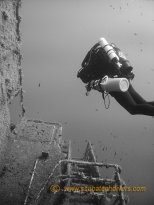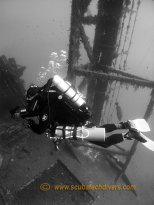









Diving Rebreathers is being hailed as the future of Scuba Diving, and you can now train to dive on the Megalodon Rebreather Unit, The Tiburon CCR or the Meg's Little Brother CCR, the Pathfinder in Cyprus with Scuba-Tech Diving Centre.
The question is, why are Rebreathers becoming so popular? What are the benefits of using CCR on a dive? How do they work and what do they do?
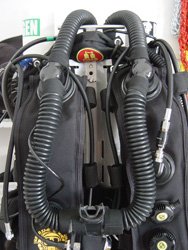
CCR stands for Closed Circuit Rebreather and essentially means that when you exhale, your bubbles are not released into the water as with normal scuba equipment. Instead, the gas you exhale is recycled back through a scrubber unit, containing grains of Sofnolime ( I won't go into the chemistry but there's a chemical reaction) which 'scrubs out' the Carbon dioxide that you exhale, meaning that you can breathe it again... or re-breathe it!!
With most Rebreather Units, and indeed the Megalodon CCR, you must have a means of injecting Oxygen into your breathing loop. Back to Physiology basics...
Oxygen is the only gas in the air that humans use in the process of respiration. We breathe air in, and we metabolise the Oxygen in the air, which our bodies use to "feed" every cell in our body. The human body cannot survive without oxygen and in partial presures of less than 0.18, we risk Hypoxia (lack of Oxygen). We then exhale the used air with a high concentration of Carbon Dioxide.
The end result is that the Oxygen in the Rebreather's breathing loop decreases as we use it up, so we need to add more periodically to maintain a breathable mix. This is done on the Megalodon by using Oxygen sensors, that work on Voting Logic. They measure the partial pressure of the Oxygen in the loop to keep it at a certain set-point, which you set manually. When the Oxygen levels drop below a certain point, the Rebreather fires Oxygen into the mix.
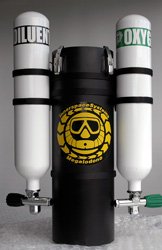
Diving with a Rebreather is beneficial in a number of ways. As mentioned earlier, you can manually set your set-point to whatever you want on the dive (your Rebreather instructor will tell you more about this on your Training Course) but usually, it is set to around 1.2 PO2. The Rebreather will then give you the optimum mix of nitrox or trimix, depending on your diluent for whatever depth you are at. For example, with a set point of 1.2 PO2, a Rebreather Diver using air diluent, at 30m will be breathing a mix of 30% nitrox. If that same diver ascends to 15m, the Rebreather maintains the 1.2 PO2, adds more Oxygen to the breathing loop and delivers a mix of 48% nitrox. This gives you an added margin of safety from narcosis and decompression and allows accelerated decompression, if you make a decompression dive.
Other Benefits of using a Rebreather over Open circuit Scuba include:
For more information regarding the Use of Rebreathers and Training Courses available in Cyprus on the Megalodon, Tiburon or Pathfinder CCR Units
For 2023 Courses on the ISC Megalodon, TIburon or Pathfinder Rebreather get in touch with us at Scuba Tech Cyprus
Learn Scuba Diving with Trained PADI & BSAC Instructors in Cyprus
Technical Diving Courses from TDI and PADI TECREC
You can find Scuba Tech Diving Centre on Trip Advisor, so don't take our word for what we offer, read the reviews of other scuba divers from around the world.
If you would like to write your own review of Scuba Tech Diving Centre, please find an easy way to do this on our Scuba Diving on Trip Advisor Review Page